
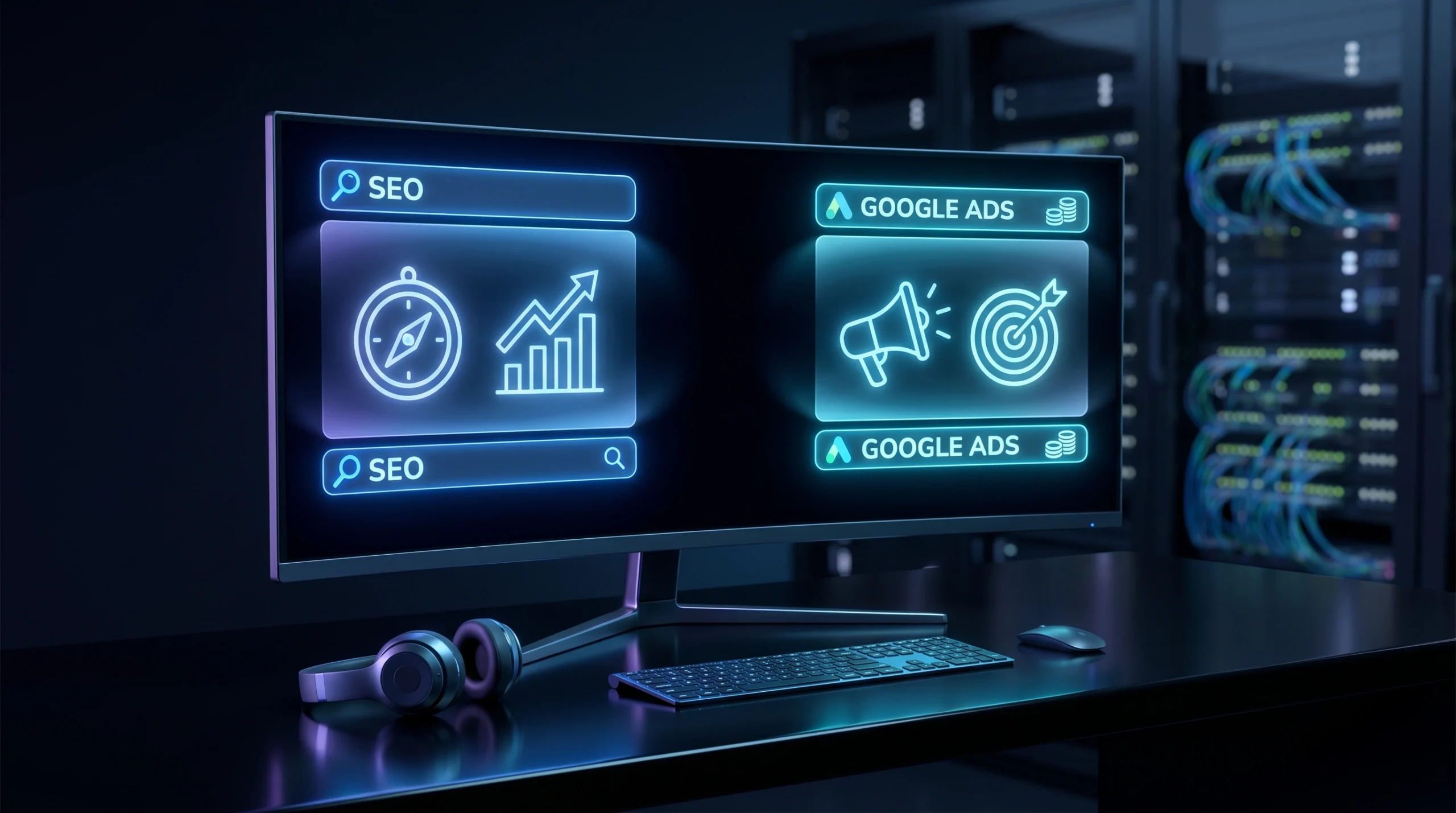
Every business owner reaches a point where they ask the same question: should I invest in SEO or Google Ads? Both drive traffic, both can boost revenue, and both have serious advocates. But they work in completely different ways, and choosing the wrong one can waste your budget or slow your growth.
This guide breaks down SEO vs Google Ads in plain terms. We will look at how each works, what each costs, when to use one over the other, and when combining both actually makes the most sense. By the end, you will have a clear picture of which strategy fits your business right now.
What Is SEO and How Does It Work?
SEO, or Search Engine Optimization, is the process of improving your website so it ranks higher in organic (unpaid) search results on Google and other search engines. When someone searches for “web design company near me” or “best eCommerce platform,” the sites that show up without an “Ad” label got there through SEO.
SEO involves several moving parts:
- On-page SEO: Optimizing page titles, headings, content, and internal links
- Technical SEO: Improving site speed, mobile-friendliness, crawlability, and structured data
- Off-page SEO: Building backlinks from reputable websites
- Content marketing: Publishing useful, keyword-rich content that answers real questions
The results from SEO are not instant. It typically takes three to six months to see meaningful movement, sometimes longer in competitive industries. But once you rank well, that traffic keeps coming without paying for every click.
You can learn more about how Google evaluates pages through Google’s Search Central documentation.
What Are Google Ads and How Do They Work?
Google Ads (formerly Google AdWords) is a paid advertising platform that lets you display your business at the top of search results almost immediately. You bid on specific keywords, and when someone searches those terms, your ad can appear above all organic results.
Google Ads includes several formats:
- Search ads: Text ads that appear in Google search results
- Display ads: Visual banner ads across Google’s partner websites
- Shopping ads: Product listings for eCommerce businesses
- YouTube ads: Video ads shown before or during YouTube content
- Remarketing ads: Ads that follow users who previously visited your site
You pay per click (PPC), meaning you are charged only when someone clicks your ad. The cost per click varies widely depending on your industry, competition, and keyword. Some clicks cost less than a dollar. Others, in competitive fields like legal services or insurance, can run $50 or more.
Google’s own Ads overview is a helpful starting point if you want to explore campaign setup.
SEO vs Google Ads: A Side-by-Side Comparison
Before diving deeper, here is a quick comparison table to highlight the core differences:
| Factor | SEO | Google Ads |
|---|---|---|
| Cost model | Time and resource investment | Pay-per-click |
| Time to results | 3 to 6+ months | Almost immediate |
| Traffic sustainability | Long-term | Stops when budget stops |
| Click-through trust | Higher (organic results) | Lower (some users skip ads) |
| Best for | Long-term growth | Quick wins, promotions |
| Control over placement | Indirect | Direct |
| Requires ongoing effort | Yes (content and links) | Yes (budget and optimization) |
| Works well for | Any business with a website | Businesses with clear ROI goals |
Neither option is strictly better. The right choice depends on your goals, timeline, and resources.
SEO vs Google Ads: Which Is Better for Long-Term Growth?
When it comes to long-term digital growth, SEO generally wins. Here is why.
SEO Builds Compounding Value Over Time
Think of SEO like planting a tree. You invest time upfront, water it consistently, and eventually it grows into something substantial. A well-optimized page can rank for years and keep bringing in traffic without additional spend per click.
For example, a Shopify store selling custom merchandise that publishes a helpful blog post on “how to design branded merchandise” could rank for that keyword and attract hundreds of qualified visitors every month, indefinitely. That is the compounding nature of SEO at work.
At Softlogics LLC, our web design and development team builds websites with SEO fundamentals baked in from the start. Clean code structure, fast loading times, and mobile-responsive layouts are not just good design choices, they are SEO requirements. A well-built site gives your SEO strategy a strong foundation to grow from.
Google Ads Stop the Moment You Stop Paying
This is the biggest limitation of paid search. The moment your budget runs out or you pause a campaign, your visibility disappears. There is no residual benefit. You are essentially renting traffic rather than building an asset.
That said, this is not always a bad thing. If you need leads this week for a product launch, Google Ads is the right tool. But if you want sustainable traffic that does not depend on a monthly ad spend, SEO is the smarter long-term investment.
SEO vs Google Ads: Which Delivers Better ROI?
This is where the conversation gets nuanced. ROI depends heavily on your industry, average customer value, and how well each channel is managed.
When Google Ads ROI Can Be Impressive
Google Ads can deliver exceptional ROI when:
- You sell a high-ticket product or service with strong margins
- Your landing page is optimized to convert visitors into buyers
- You are targeting buyers who are ready to purchase (bottom of funnel)
- You have a team or agency that actively manages and optimizes campaigns
For instance, a software company offering a $500/month SaaS product can afford a $30 cost per click if even 5% of visitors convert. The math works.
When SEO Delivers Better ROI
SEO tends to deliver better ROI over 12 to 24 months when:
- You are building content that answers multiple customer questions
- Your niche is not hyper-competitive with enormous ad budgets
- You have a strong website that converts organic visitors well
- You can invest in consistent content creation and link building
A local service business, like a plumbing company or a UI/UX design studio, can dominate local search results through targeted SEO and bring in steady leads without paying for every click.
The Role of Website Quality in Both Strategies
Here is something many businesses overlook: neither SEO nor Google Ads will perform well if your website is poorly designed.
Google evaluates page experience as a ranking factor for SEO. And Google Ads assigns a Quality Score to your landing pages, which directly affects how much you pay per click and how often your ad shows.
A slow, cluttered, or confusing website kills conversions from both channels.
This is where Softlogics LLC’s full-service approach makes a real difference. Our UI/UX design team creates clean, intuitive experiences that keep visitors engaged. Our graphic design and branding work ensures your site looks credible and professional. And our website maintenance services keep everything running fast and secure over time.
Whether traffic is coming from organic search or a paid campaign, your website needs to convert that traffic. A great-looking site built on a poor foundation will always underperform.
SEO vs Google Ads for Specific Business Types
Different businesses have different needs. Here is a practical breakdown:
Small Businesses and Startups
If your budget is tight, starting with SEO is usually smarter. Google Ads can drain a small budget quickly without a clear strategy in place. Focus on building your website, creating helpful content, and earning local citations first.
That said, a small, well-targeted Google Ads campaign with a $300-$500 monthly budget can generate real leads if your landing page is solid and your offer is clear.
eCommerce Businesses
eCommerce is one area where both channels shine, and using them together is especially effective.
Google Shopping Ads can drive immediate sales for specific products. Meanwhile, SEO-driven blog content and category pages build long-term organic traffic. A Shopify store, for example, can run ads to promote a seasonal sale while simultaneously building organic rankings for product-related keywords.
Softlogics LLC offers full Shopify and eCommerce development services, from initial store setup to custom feature development and performance optimization. We help eCommerce brands build a site that works hard on both fronts.
Service-Based Businesses
Law firms, marketing agencies, consulting companies, and IT service providers often do well with both. Google Ads can target high-intent searchers (“hire mobile app developer”), while SEO content builds authority and trust over time through informative blog posts and case studies.
B2B Software and SaaS Companies
SEO content marketing is particularly powerful for SaaS companies. Detailed blog posts, comparison guides, and how-to articles bring in qualified leads who are actively researching solutions. Paid search works well for capturing demand from buyers further along in the sales cycle.
Common Mistakes Businesses Make Choosing Between SEO and Google Ads
Many businesses make costly mistakes when deciding between these two channels. Here are the most common:
- Running Google Ads to a weak website. Paid traffic is only as good as the page it lands on. If your site is slow, outdated, or confusing, you are burning money.
- Expecting SEO to work overnight. SEO is a long game. Businesses that give up after two months never see the results that come at month six.
- Ignoring keyword intent. Ranking for informational keywords through SEO while using Google Ads for transactional keywords is a smart split. Mixing them up wastes resources.
- Not tracking conversions properly. Without solid analytics and conversion tracking, you cannot tell what is actually working. Google Analytics 4 and Google Ads conversion tracking are essential tools.
- Treating both as separate silos. SEO and Google Ads data can inform each other. Keywords that convert well in paid campaigns are worth targeting with SEO content.
When Using SEO and Google Ads Together Makes Sense
The question is not always “SEO vs Google Ads which is better.” Sometimes the right answer is both.
Here is a smart combined strategy:
- Use Google Ads to generate immediate leads and revenue while your SEO strategy matures
- Use SEO content to build long-term authority and reduce your dependence on ad spend over time
- Test keyword performance with paid campaigns before committing to content creation for those terms
- Use remarketing ads to re-engage visitors who found you through organic search but did not convert
This dual approach works especially well for growing businesses that need results now but also want to build sustainable traffic over the next 12 to 24 months.
At Softlogics LLC, our digital marketing team manages both SEO and PPC campaigns, often running them in parallel to maximize results at different stages of the customer journey. We combine this with social media marketing to create a cohesive digital presence across channels.
How Softlogics LLC Supports Your Digital Growth Strategy
Whether you choose SEO, Google Ads, or a mix of both, you need the right foundation and the right team. Here is how Softlogics LLC supports businesses at every stage:
- Web Design and Development: Fast, SEO-ready websites that convert visitors into customers
- Custom Software Development: Scalable digital tools that automate operations and improve efficiency
- Mobile App Development: Apps that extend your reach and improve the customer experience
- UI/UX Design: User-centered design that reduces friction and improves conversion rates
- Graphic Design and Branding: Consistent visual identity that builds trust across all channels
- Digital Marketing: SEO, PPC, and social media strategies tailored to your business goals
- Website Maintenance: Ongoing technical support to keep your site fast, secure, and up to date
- Shopify and eCommerce Development: Online stores built to perform and scale
- E-Book Publishing: Ghostwriting, editing, and audiobook production for thought leadership content
If you want to grow your digital presence and need a team that understands both strategy and execution, contact Softlogics LLC for a free consultation.
Conclusion: SEO vs Google Ads, Which Is Better?
The honest answer is that neither is universally better. The right choice depends on where your business is right now, what your goals are, and how much time and budget you have.
If you need results quickly and have a clear budget, start with Google Ads. If you are building for the long term and want traffic that does not stop when your budget does, invest in SEO. And if you want the best of both, use them together with a clear strategy that connects the two.
What matters most is that you have a great website, a clear offer, and a consistent approach. The channel is just a vehicle. The foundation is everything.
Work with Softlogics LLC to build that foundation right the first time.
Frequently Asked Questions
1. Is SEO or Google Ads better for a new business?
For a brand-new business, Google Ads can generate leads faster while your SEO strategy builds momentum. Starting with a small, targeted ad campaign alongside foundational SEO work is usually the most effective approach.
2. How long does SEO take to show results?
Most businesses see meaningful SEO results within three to six months. Competitive industries can take longer. Consistent content creation, technical optimization, and link building all speed up the process.
3. Is Google Ads worth it for small businesses?
Yes, if managed correctly. A focused campaign targeting high-intent local keywords with a well-designed landing page can generate solid ROI even on a limited budget. Poor management, however, can burn through money quickly.
4. Can SEO and Google Ads work together?
Absolutely. Many successful businesses use both. Google Ads provides immediate visibility and data, while SEO builds long-term organic authority. Running both simultaneously often produces better results than either alone.
5. What happens to my traffic if I stop Google Ads?
It stops immediately. Unlike SEO, paid search traffic has no residual value. Once your budget runs out or campaigns are paused, your ads disappear from search results.
6. Does having a Google Ads campaign help my SEO rankings?
No. Google keeps paid and organic results completely separate. Running Google Ads does not improve your organic search rankings. However, the keyword data from your campaigns can inform your SEO content strategy.
7. How much does SEO cost compared to Google Ads?
SEO typically involves a monthly retainer for services like content creation, technical optimization, and link building, usually ranging from $500 to $5,000 or more per month depending on scope. Google Ads costs vary based on your industry and budget but require ongoing ad spend on top of any management fees. SEO tends to be more cost-efficient over the long term.