
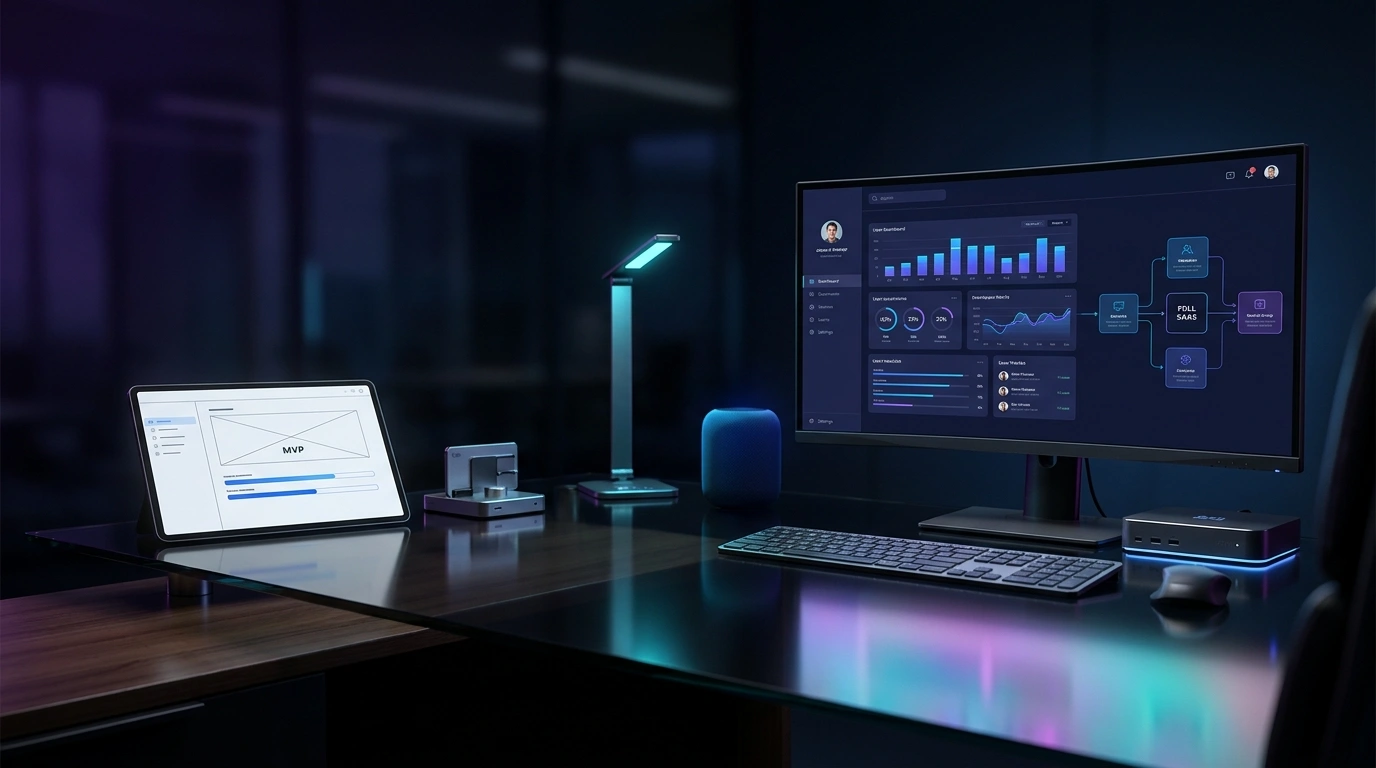
If you’ve got a software idea and a budget that isn’t unlimited (and let’s be honest, whose is), you’ve probably wrestled with this question already: build an MVP, or go all in on a full SaaS product from day one? It’s one of those decisions that feels small on paper but can quietly eat months of development time and a chunk of your runway if you get it wrong.
Here’s the uncomfortable truth: there’s no universal answer. What works for a two-person startup testing a hunch is not what works for a funded team with three years of industry data already in hand. The right call depends on how validated your idea is, how much risk you can absorb, and what your customers actually expect before they’ll trust you with their money.
We’ve sat across the table with founders asking this exact question at Softlogics LLC, some of them building their very first product, others scaling something that already had paying customers. So instead of giving you a generic “it depends,” we want to walk through what an MVP and a full SaaS product really mean, where each one shines, and how to figure out which one fits your situation right now.
What Is an MVP, Really?
MVP stands for Minimum Viable Product, but that name trips people up. It doesn’t mean “the cheapest, half-broken version you can ship.” It means the smallest version of your product that still solves one real problem well enough that people will actually use it.
The thinking behind this comes from lean startup methodology, which basically argues that founders waste less time and money when they build, test, and learn in short loops instead of disappearing for a year to build something nobody asked for. According to HubSpot’s sales blog, this kind of approach lets teams gather real feedback without burning through resources on features that might not even matter.
A few products you’ve probably used started out as nothing more than an MVP:
- A file-sharing tool that’s now everywhere launched with just a short demo video to see if anyone even cared before a working product existed.
- A social media scheduling app started life as two landing pages, nothing else, just to test if people would actually sign up.
- A massive online retailer began as a single product category, used to validate demand before anything else got added.
None of these are examples of cutting corners. They’re examples of being smart about where the money goes before you know if anyone wants what you’re building.
What an MVP Usually Looks Like
- It includes only the features needed to solve the one problem you’re testing
- It can usually be built in a few weeks to a couple of months, not a year
- It’s designed from the start to collect honest feedback, not just praise
- It costs noticeably less than a full build
- If something’s not working, you can change direction without losing your shirt
And What’s a Full SaaS Product, Then?
A full SaaS product is the real deal: complete, polished, built to handle scale from the moment it launches. We’re talking proper infrastructure, multiple user roles, billing systems that actually work, integrations with the tools your customers already rely on, and security that holds up under scrutiny.
Where an MVP is built to test an idea, a full SaaS product is built to support thousands (sometimes millions) of users without falling over. That usually means:
- Multi-tenant architecture so the platform can safely serve many customers at once
- Role-based permissions, because not every user should see everything
- Subscription billing and payment processing baked in
- Dashboards and analytics that actually help customers make decisions
- Integrations with the software your customers already use day to day
- Security and compliance measures, which matter a lot more if you’re in finance or healthcare
Building this from scratch takes real time, a real budget, and a team that understands SaaS architecture, not just “can build a website.” This is exactly where working with a partner experienced in SaaS application development pays off, since the technical choices made on day one quietly decide how painful (or painless) scaling will be later.
MVP vs Full SaaS Product, Side by Side
Sometimes a table just makes things click faster than paragraphs do.
| Factor | MVP | Full SaaS Product |
|---|---|---|
| Time to launch | Weeks to a couple of months | Several months, often a year or more |
| Initial cost | Lower, tightly focused | Higher, real investment required |
| Feature set | Core features only | The complete picture |
| Risk level | Lower, easy to pivot | Higher, harder to walk back |
| Best fit for | Testing a new idea | Ideas already proven, ready to scale |
| Feedback loop | Fast, almost immediate | Slower, comes after launch |
| Built for scale? | Not really, that’s not the point | Yes, from the ground up |
This is a good starting point, but it’s not the whole picture. Your specific situation still matters more than any table.
Why Most Successful Startups Start Lean
Building an MVP first tends to be the safer move for most new software ideas. Here’s why.
You find out if the idea actually holds up, before spending big. It’s a lot cheaper to discover your assumption was wrong after a small build than after a full one. An MVP puts your idea in front of real users instead of leaving it to guesswork.
You get feedback that’s actually useful. No amount of planning beats watching real people use your product. They’ll find problems you never considered, and opportunities too.
Your financial risk stays manageable. Founders who skip this step often end up spending two or three times what they planned, only to learn the market wanted something slightly (or completely) different.
Investors like proof more than promises. A working product with even a small amount of traction beats a polished pitch deck full of assumptions, every time.
Pivoting doesn’t feel like starting over. If feedback shows you need to shift direction, doing that with an MVP is a lot less painful than doing it after a full build.
But Sometimes Going Straight to Full SaaS Makes Sense
Starting lean is usually the smarter call, but not always. There are real situations where building the full product right away is justified.
- You’ve already validated demand. Maybe you’ve run pilots, signed early customers, or you’ve spent years in this exact industry and already know what’s needed.
- Your customers are enterprises. Big companies often won’t even consider a tool unless it already has the security, compliance, and integration features they require. A bare-bones MVP won’t survive their procurement process.
- You’re in a regulated space. Healthcare, finance, legal: these industries often require certain protections to exist before launch, not after the fact.
- You’re well funded with a clear plan. If your funding was raised specifically to build a complete product, and your team genuinely understands the market, building with scale in mind from the start can be the right move.
- You’re replacing something you already use. Sometimes a business knows exactly what it needs because they’ve been limping along with a manual process or an outdated tool for years.
In any of these cases, partnering with a team that handles custom software development and SaaS architecture properly from day one saves you from an expensive rebuild down the road.
What You Risk by Skipping the MVP Stage
Jumping straight into a full SaaS build without testing the idea first isn’t automatically wrong, but it does come with risk worth thinking through.
You’re exposing more money to an unproven idea. A full build with no validation means a much bigger budget riding on assumptions nobody’s actually confirmed yet. You’ll also likely take longer to reach the market, which gives smaller, faster competitors room to test and learn while you’re still building. And once a full system exists, changing its core functionality gets expensive fast, nothing like the flexibility you have with an early MVP.
There’s also a quieter risk: feature overload. Teams without real user feedback tend to guess at what’s needed, and that guessing often results in extra complexity nobody asked for. And don’t underestimate team burnout either. Long development cycles with no launch and no feedback loop can drain momentum faster than people expect.
How Softlogics LLC Fits Into Whichever Path You Choose
Whether you land on an MVP or decide a full SaaS build is the right call, having the right technical partner is what separates a smooth launch from a frustrating one. Here’s how our team at Softlogics LLC supports businesses at each stage.
Our SaaS application development work is built around helping companies design software that can actually grow with demand, not just survive it. Whether you’re validating your very first MVP or scaling into a full multi-tenant platform, we focus on clean architecture and secure infrastructure instead of recycled templates.
For businesses with workflows that don’t fit neatly into an off-the-shelf tool, our custom software development team builds solutions shaped around how you actually work, not how a generic SaaS template assumes you work.
A great idea with a confusing interface struggles no matter what stage it’s at. That’s where UI/UX design comes in. Clean, intuitive layouts directly affect conversions and how many users stick around after their first session.
A lot of SaaS products need a mobile companion these days, and our mobile app development team builds both native and cross-platform apps that extend your reach beyond the browser.
Your product also needs somewhere for people to land before they ever sign up. Our web design and development team builds fast, conversion-focused sites that support your launch from the very first day.
Branding matters more than founders expect. A polished logo, consistent colors, and graphics that look intentional all help your product feel credible to users and investors alike. We handle that through our graphic design and branding services.
None of this matters if nobody finds your product, which is where our digital marketing services come in: SEO, PPC, and social media marketing that put your product in front of the right people instead of just anyone.
Once you’re live, the work isn’t over. Our website maintenance service keeps your platform fast, secure, and stable as your user base (hopefully) keeps growing.
If your SaaS product has any kind of online store, marketplace, or subscription checkout built into it, our Shopify and eCommerce development team can integrate smooth payment flows directly into the platform.
And for founders looking to build authority around their product, our e-book publishing services, including ghostwriting, editing, and audiobook production, turn your expertise into content that supports both marketing and credibility.
A Practical Path From MVP to Full SaaS Product
If you’re starting lean, here’s roughly how that journey tends to play out over time.
- Validate the problem first. Talk to potential users before writing a single line of code. Make sure the pain point is real.
- Build a focused MVP. Stick to only the features needed to test your core idea.
- Launch it and actually watch how people use it. Don’t just collect opinions, pay attention to behavior.
- Iterate based on what you learn. Fix friction points, remove anything that isn’t pulling its weight.
- Plan your scaling architecture once demand is proven. Build for where you’re headed, not just where you are today.
- Expand into a full SaaS product. Add the integrations, security, and enterprise features your growing customer base now expects.
- Keep investing in marketing and retention. SEO, paid campaigns, and social media keep the pipeline full while onboarding and support keep people from leaving.
This isn’t a fixed timeline. Some companies move through these stages in under a year. Others take two or three, depending on funding and how the market responds.
A Quick Real-World Scenario
Picture a logistics company wanting to build a SaaS platform that helps small trucking businesses manage routes, fuel costs, and driver schedules. Building every possible feature before launch would take a year, easily. The smarter move is launching an MVP that handles just route planning and basic scheduling, nothing more.
Once a handful of trucking companies are actually using it and giving honest feedback, the team can figure out whether fuel tracking, driver communication, or invoicing should come next. That approach saves money, skips the guesswork, and builds toward what users are actually asking for instead of what the team assumed they’d want.
This is exactly the kind of project where having an experienced SaaS application development team involved early pays off. The right technical foundation at the MVP stage makes expanding later a lot less painful, and a lot less expensive.
So, Which One Is Right for You?
Ask yourself these questions honestly:
- Have I actually confirmed people want this, or am I assuming they will?
- Can my budget absorb the risk of building a full product without testing first?
- Are my target customers enterprises who’ll expect full features before they’ll even try it?
- Am I in a regulated industry where compliance isn’t optional?
- Do I need fast feedback to shape this idea, or do I already know exactly what to build?
If most of those answers point toward uncertainty, start with an MVP. It’s almost always the safer bet. If your answers show strong validation, solid funding, and a clear technical roadmap, a full SaaS build from the start might genuinely be the better fit.
Either way, the goal stays the same: build something that solves a real problem well enough that people are willing to pay for it.
Final Thoughts
The MVP vs full SaaS product decision doesn’t have to keep you up at night. Be honest with yourself about how validated your idea really is, how much risk you can stomach, and what your customers expect before they’ll trust you. Most businesses do better starting lean, learning fast, and scaling once the demand is actually there.
If you’re trying to figure out the right path for your own product, our team at Softlogics LLC is happy to talk it through. From custom software development and SaaS application development to UI/UX design, digital marketing, and ongoing website maintenance, we support businesses at every stage of this process.
Work with Softlogics LLC to turn your idea into something people genuinely want to use. Get a free consultation with our team and let’s figure out the smartest way to build, launch, and grow what you’re working on.
Frequently Asked Questions
1. What’s the actual difference between an MVP and a full SaaS product? An MVP includes only the core features needed to test an idea with real users. A full SaaS product includes the complete feature set, advanced security, integrations, and infrastructure built to handle large-scale growth.
2. How long does it usually take to build an MVP? Most MVPs take anywhere from a few weeks to a couple of months, depending on complexity. A full SaaS product typically takes several months, sometimes well over a year.
3. Is an MVP actually cheaper than building a full SaaS product? Yes, noticeably. Since an MVP focuses only on core functionality, development costs are significantly lower than building out every feature of a full platform from the start.
4. Can my MVP eventually become a full SaaS product? Absolutely, and that’s how many successful SaaS companies got their start. They began as simple MVPs and gradually added features, scalability, and integrations as their user base grew. Planning the architecture properly early on makes that transition much smoother.
5. What features should I actually include in an MVP? Only the ones required to solve the main problem your target users face. It’s tempting to add more, but extra functionality should wait until real feedback confirms it’s actually needed.
6. Do I need a development partner, or can I build this myself? Some founders with technical backgrounds build early prototypes solo, and that’s fine for a first test. But working with an experienced team helps you avoid costly architecture mistakes and speeds things up considerably, especially if scaling is part of the plan.
7. How does Softlogics LLC help businesses choose between an MVP and a full SaaS product? We look at your business goals, budget, target market, and technical requirements, and recommend the starting point that actually fits your situation. From there, we support the build through custom software development, SaaS application development, UI/UX design, and digital marketing to help your product grow the right way.
Ready to build your next product the right way? Contact our team at Softlogics LLC for a free consultation, and let’s figure out whether an MVP or a full SaaS product makes the most sense for your business.